
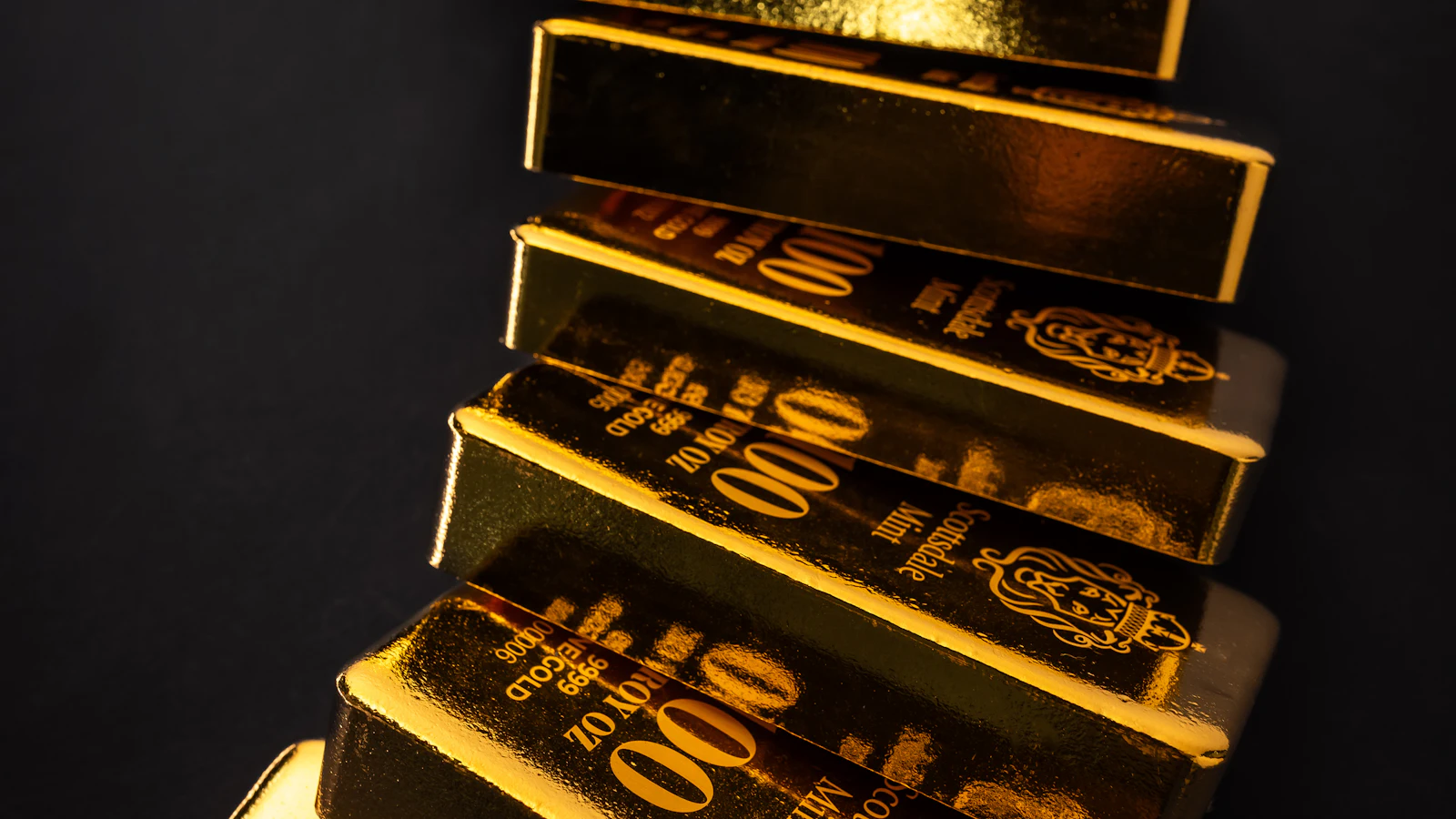
Gold, oil and the world's big indices.
Trade metals, energy and the indices investors watch most. Typical spreads are shown in points, before you trade.
- Instruments
- 16
- Trading hours (UK time)
- Metals and energy 23:00 Sunday to 22:00 Friday; grains and coffee and indices in their own hours
- Typical cost
- Spreads from 3.0 points on gold
- Leverage
- No leverage
What commodities and indices are.
A commodity is a raw material bought and sold in standard grades: metals such as gold, silver, platinum, palladium and copper, energy such as crude oil and natural gas, and farm products such as wheat, corn, soybeans and coffee. Their prices are set by how much is produced and how much is wanted.
An index measures a group of shares as a single number. The S&P 500 follows 500 large US companies, the Nasdaq 100 follows 100 large companies listed on Nasdaq, and the Dow Jones follows 30 large US companies. The FTSE 100, DAX 40, CAC 40 and Euro Stoxx 50 do the same for Britain, Germany, France and the euro area, and the Nikkei 225 and Hang Seng for Japan and Hong Kong.
On Replicate Traders you trade the price of these markets, not the metal, the oil or the shares behind them: you never take delivery. Metals, energy and farm products are priced in US dollars (the grain and coffee futures are quoted in US cents, and shown here in dollars), and spreads are quoted in points. A point is the smallest quoted step; on gold it is $0.10 an ounce, and on an index it is one index point.
What moves commodity and index prices.
Commodity prices move with supply and demand: oil with production decisions, inventories and conflict; gold with interest rates, the dollar and demand for safe assets; metals with industrial demand. Indices move with the large companies in them, interest-rate expectations and the wider economy. Weather, holidays and geopolitical news can move prices quickly.
- Gold: rates, the dollar and fear
- Gold pays no interest, so when interest rates after inflation are low, holding it costs little and its price tends to do well. A stronger dollar usually makes it dearer for buyers elsewhere, and fear in markets often sends money towards it.
- Oil and gas: supply, stocks and weather
- Production decisions by large producers, the amount held in storage, conflict and weather in producing and consuming regions all move energy prices. Natural gas is especially sensitive to the weather.
- Industrial metals: factories and building
- Copper goes into buildings, wiring and electronics, and platinum into car exhaust systems and jewellery, so their prices follow how busy industry is and how much is being built.
- Indices: the big companies inside
- An index moves with the largest companies in it, with interest-rate expectations and with the wider economy. Results season and central-bank decisions are usually the busiest times.
Commodities and indices trading hours.
Each bar is a 24-hour day in UK time. The gold stretch is when the market trades.
-
Metals and energy Sunday 23:00 to Friday 22:00, daily break 22:00 to 23:00
-
US indices 14:30 to 21:00, Monday to Friday
-
UK and European indices 08:00 to 16:30, Monday to Friday
-
Nikkei 225 00:00 to 06:00, Monday to Friday
-
Hang Seng 01:30 to 08:00, Monday to Friday
Metals and energy trade from Sunday 23:00 to Friday 22:00 UK time, with a daily break from 22:00 to 23:00. Indices follow their own exchange, in UK time: US indices from 14:30 to 21:00, UK and European indices from 08:00 to 16:30, and the main Asian indices overnight.
Grain futures trade from Monday 01:00 to Friday 19:20, with a daily break from 13:45 to 14:30. Coffee trades from 09:15 to 18:30, Monday to Friday. Public holidays and clock changes can shorten these sessions or move them by an hour. The platform shows the current session for each instrument.
Each index follows its own exchange, so together they hand the day from Asia to Europe to the US. Public holidays and clock changes can shorten these sessions or move them by an hour.
When a market is closed
Metals and energy pause for an hour every day, from 22:00 to 23:00, and close from Friday 22:00 to Sunday 23:00. Each index is closed outside its exchange hours. In every case the price on screen is the last close, and once it is older than the market accepts (two minutes, or the delay of a late market plus two minutes) orders are refused until the market reopens.
Outside its trading hours a market has no new prices. The price on screen is the last close. It can still be traded for a short while after the close, until the price we hold is older than the market accepts: 2 minutes for most markets, and a little longer for the markets whose free data arrives late (the delay of that data plus 2 minutes). After that, buying and selling are refused until the market opens and the price updates.
Commodities and indices to trade.
Every instrument in this market, their trading hours in UK time and their typical spread or cost.
| Instrument | Name | Trading hours (UK time) | Typical spread or cost |
|---|---|---|---|
| XAU/USD | Gold | Sunday 23:00 to Friday 22:00 (daily break 22:00–23:00) | From 3.0 points |
| XAG/USD | Silver | Sunday 23:00 to Friday 22:00 (daily break 22:00–23:00) | From 2.0 points |
| XPT/USD | Platinum | Sunday 23:00 to Friday 22:00 (daily break 22:00–23:00) | From 5.0 points |
| WTI | WTI crude oil | Sunday 23:00 to Friday 22:00 (daily break 22:00–23:00) | From 3.0 points |
| BRENT | Brent crude oil | Sunday 23:00 to Friday 22:00 (daily break 22:00–23:00) | From 4.0 points |
| NGAS | Natural gas | Sunday 23:00 to Friday 22:00 (daily break 22:00–23:00) | From 4.0 points |
| COPPER | Copper | Sunday 23:00 to Friday 22:00 (daily break 22:00–23:00) | From 3.0 points |
| US500 | S&P 500 index | 14:30 to 21:00, Monday to Friday | From 0.4 points |
| US100 | Nasdaq 100 index | 14:30 to 21:00, Monday to Friday | From 1.0 points |
| US30 | Dow Jones index | 14:30 to 21:00, Monday to Friday | From 2.0 points |
| UK100 | FTSE 100 index | 08:00 to 16:30, Monday to Friday | From 1.0 points |
| GER40 | DAX 40 index | 08:00 to 16:30, Monday to Friday | From 1.2 points |
| FRA40 | CAC 40 index | 08:00 to 16:30, Monday to Friday | From 1.5 points |
| EU50 | Euro Stoxx 50 index | 08:00 to 16:30, Monday to Friday | From 1.5 points |
| JP225 | Nikkei 225 index | 00:00 to 06:00, Monday to Friday | From 6.0 points |
| HK50 | Hang Seng index | 01:30 to 08:00, Monday to Friday | From 5.0 points |
Some commodities and indices use free price data that arrives late: about 11 to 12 minutes for silver, platinum, copper, oil and natural gas, 17 minutes for palladium, 21 minutes for coffee, 15 minutes for grains, and 16 to 21 minutes for the FTSE 100, DAX 40, CAC 40, Euro Stoxx 50, Russell 2000, IBEX 35, Swiss Market, Nikkei 225, Hang Seng, Shanghai and ASX 200 indices. You can trade them at that late price: the order fills at the price on the screen, and the trade screen says how late it is. A late market keeps taking orders at its closing price for the length of its delay plus 2 minutes after it closes.
Typical spreads are for a standard account while the market is liquid; they can widen around news and at the open. No commission; the spread is the cost, and it is shown before you confirm. Trading is unleveraged: you can lose what you put in, not more.
XAU/USD, live.
The live chart for this market's lead instrument. Prices are indicative and may be delayed.
How a trade works here.
Four steps, the same in every market. Nothing is borrowed, and the price you see is the price you trade at.
-
Pick an instrument and read its two prices
Every instrument shows a buy price and a sell price. You buy at the higher one, the ask, and you sell at the lower one, the bid. The gap between them is the spread, and it is the only thing a trade costs: there is no commission.
-
Choose how much to buy
Enter an amount. The smallest buy order is $10. It is paid from the money in your account, so nothing is borrowed and there is no leverage. Real-money trading needs an approved identity check; the demo balance does not.
-
Confirm, and the order fills at the live price
A market order fills straight away at the live price: a buy at the ask, a sell at the bid. If the price has moved against you by more than twice the spread since you last looked, the order stops and asks you to check the new price, so you never fill at a price you were not shown.
-
Sell to close
You close a position by selling what you hold. You can only sell what you own, so the most a position can lose is what you put into it. Limit and stop orders are there too: they wait until the price reaches the level you set.
The rules the platform keeps for you.
- No leverage
- You trade with your own money only. You can lose what you put in, not more.
- No stale prices
- Every market has a limit on how old a price we take. For most it is 2 minutes. A few use free data that arrives late, such as shares outside the US, futures and some indices: they take a price up to that delay plus 2 minutes old, so you trade at the late price the screen shows, and the screen says how late it is. If the latest price we hold is older than the market's limit, it is treated as closed and the order is refused with this message: "This market's price is delayed or the market is closed, so it can't be traded right now."
- Price protection
- A market order is refused if the fill would be worse than the price you confirmed by more than twice the spread. A better price is fine.
- Practise first
- Every account comes with a $100,000.00 demo balance. Demo money is separate from real money.
What can go wrong.
Investing and trading involve risk. The value of your investments can go down as well as up, and you may get back less than you put in. Past performance is not a guide to the future.
Sharp moves on news
Gold can trend for months and then jump on a single interest-rate decision. Oil can move on a headline about supply. Spreads widen when it happens.
Where the prices come from
Gold's price follows a source that tracks the spot price, and falls back to gold futures if that source is unavailable. Silver, platinum, oil, natural gas and copper follow futures contracts, so they can sit a little apart from the spot prices quoted elsewhere. The free data for those futures arrives late, by the minutes given under the table, and an order fills at that late price.
Gaps at the open
An index can open well away from its last close after news arrives overnight, and you cannot trade while its exchange is shut.
Unleveraged is not risk-free
You trade only with your own money, so you can lose what you put in but not more. A commodity or an index can fall for a long time.
Anything about trading hours, costs or the rules is in the table, the chart and the sections above. For anything else, the help centre has more.
Questions about commodities and indices.
What hours do commodities trade?
Metals and energy trade from Sunday 23:00 to Friday 22:00 UK time, with a daily break from 22:00 to 23:00. Trading holidays can shorten these sessions.
What hours do indices trade?
Each index follows its own exchange, in UK time: US indices from 14:30 to 21:00, UK and European indices from 08:00 to 16:30, and Asian indices overnight. Clock changes can move the sessions by an hour.
What is a point?
A point is the smallest quoted step in an index or commodity price. Spreads on these instruments are shown in points, and the table above gives typical values.
Do I take delivery of gold or oil?
No. You trade the price. You buy and sell at the price shown, and no metal or oil is delivered to you.
What does a point cost on gold?
A gold point is $0.10 an ounce, so the 3.0-point starting spread is $0.30 an ounce. Other instruments have their own point size, and the spread is shown before you confirm.
Why does gold pause every evening?
Metals and energy take a daily break from 22:00 to 23:00 UK time. The price on screen is the last close until trading resumes, and orders are refused once that price is older than the market accepts.
Open an account to trade commodities and indices.
Trading is unleveraged: you can lose what you put in, not more.