
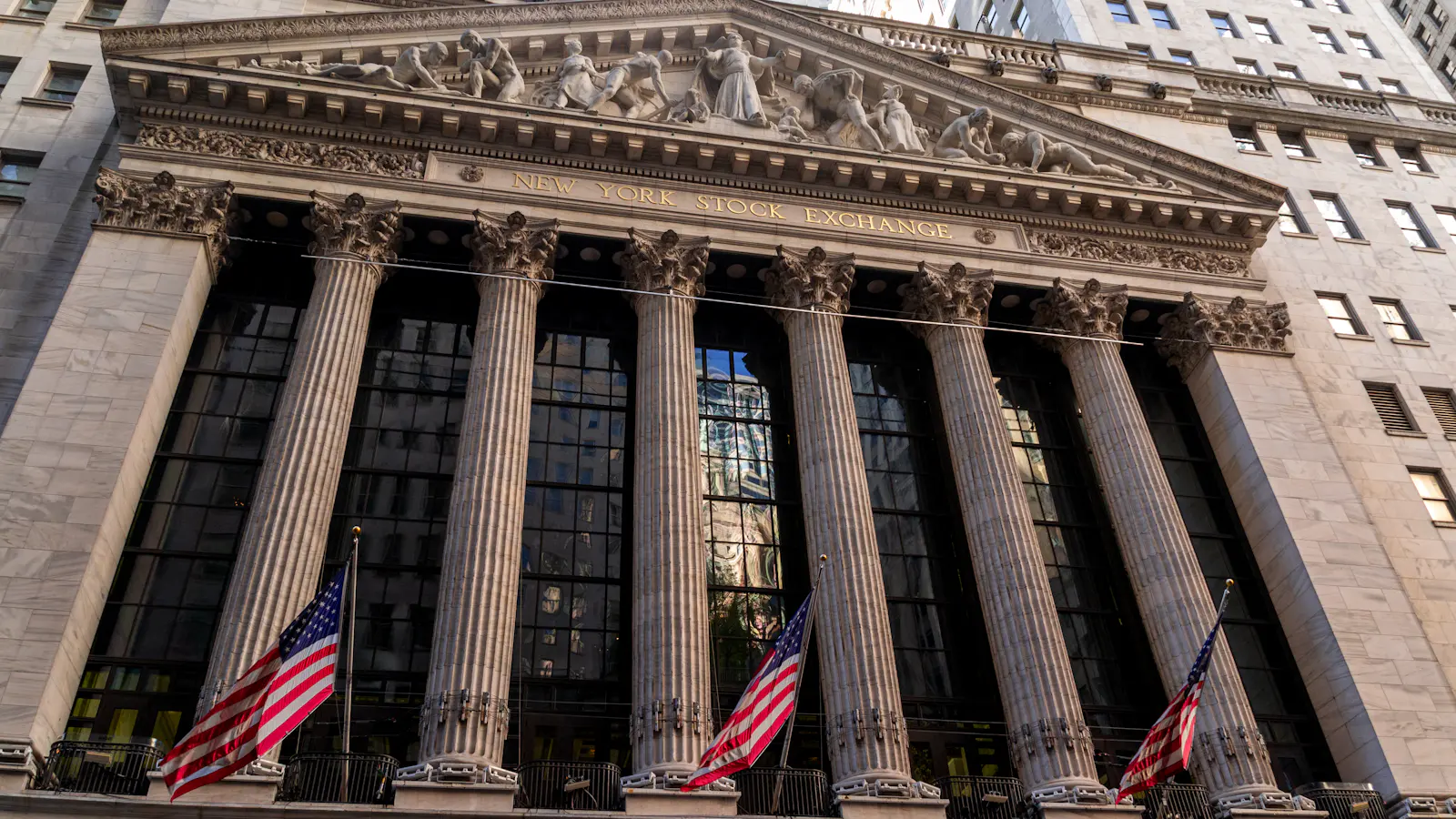
Stocks and ETFs, without the commission.
Trade large companies from the US, the UK, Europe and Asia, and the funds that track the main indices. There is no commission, and the spread is shown before you confirm.
- Instruments
- 15
- Trading hours (UK time)
- US 14:30 to 21:00; UK and Europe 08:00 to 16:30; Asia overnight; Monday to Friday
- Typical cost
- No commission — spread shown before you confirm
- Leverage
- No leverage
What shares and ETFs are.
A share is a small piece of a company. Its price is what buyers and sellers agree on during the trading day, and it reflects what they expect the company to earn in the future. When more people want to buy than sell, the price rises; when more want to sell, it falls.
An exchange-traded fund, or ETF, is a basket of shares that trades as one. SPY follows the S&P 500, an index of 500 large US companies, and QQQ follows the Nasdaq-100, an index of 100 large companies listed on Nasdaq. Buying a fund spreads your money over all the companies in it.
On Replicate Traders you trade large companies from the US, the UK, Europe and Asia, such as Apple, HSBC, Siemens and Toyota, and ETFs from those two funds to sector and bond funds. Shares quoted in pounds, euros, yen and other currencies are shown and traded in US dollars. Orders are in quantities that can include part of a share, and the smallest buy order is $10, so you do not need the price of a whole share.
What moves share prices.
Share prices move with company results and guidance, new products and management changes, and interest rates. The wider market and a company's sector often move together, and an exchange-traded fund follows the index it tracks. Results season and central-bank decisions are usually the busiest times.
- Company results
- Companies report their sales and profit every three months. A share can move sharply on the day, depending on whether the results and the outlook beat or miss what investors expected.
- Interest rates
- Higher rates make borrowing dearer and make safer savings more attractive, which tends to weigh on share prices, most of all for fast-growing companies whose profits are further away. Lower rates tend to help.
- The sector and the index
- Shares in the same industry often move together, and the largest companies carry a big weight in the indices. A fall in a few big technology shares can pull a whole fund down with them.
- News and products
- New products, lawsuits, changes of management and new regulation can move one company without moving the market at all.
Stocks and ETFs trading hours.
Each bar is a 24-hour day in UK time. The gold stretch is when the market trades.
-
US shares and ETFs 14:30 to 21:00, Monday to Friday
US shares and ETFs trade from 14:30 to 21:00 UK time, Monday to Friday. Those are the regular session hours of the New York Stock Exchange and Nasdaq.
UK, German, French, Dutch and Swiss shares trade from 08:00 to 16:30 UK time. Tokyo and Seoul shares trade from 00:00 to 06:30, with a lunch break in Tokyo from 02:30 to 03:30. Hong Kong shares trade from 01:30 to 08:00, with a lunch break from 04:00 to 05:00.
In the weeks when the UK and US clock changes are out of step, the session moves by an hour in UK time. Exchange holidays can shorten a session or close the market for the day.
The bar is the regular session of the New York Stock Exchange and Nasdaq. UK and European shares trade from 08:00 to 16:30 UK time and Asian shares overnight (the hours are listed above). When the UK and the US change their clocks on different dates, the US session moves by an hour in UK time, and exchange holidays can shorten a session or close the market for the day.
When a market is closed
Outside its exchange's hours (14:30 to 21:00 UK time for US shares), at weekends and on exchange holidays, the price is the last close from the previous session. It can be traded for a few minutes after the close (two for US shares, a little longer for shares whose free data arrives late), and then not until the market opens and the price updates.
Outside its trading hours a market has no new prices. The price on screen is the last close. It can still be traded for a short while after the close, until the price we hold is older than the market accepts: 2 minutes for most markets, and a little longer for the markets whose free data arrives late (the delay of that data plus 2 minutes). After that, buying and selling are refused until the market opens and the price updates.
Stocks and ETFs to trade.
Every instrument in this market, their trading hours in UK time and their typical spread or cost.
| Instrument | Name | Trading hours (UK time) | Typical spread or cost |
|---|---|---|---|
| AAPL | Apple | 14:30 to 21:00, Monday to Friday | No commission — spread shown before you confirm |
| MSFT | Microsoft | 14:30 to 21:00, Monday to Friday | No commission — spread shown before you confirm |
| NVDA | Nvidia | 14:30 to 21:00, Monday to Friday | No commission — spread shown before you confirm |
| TSLA | Tesla | 14:30 to 21:00, Monday to Friday | No commission — spread shown before you confirm |
| AMZN | Amazon | 14:30 to 21:00, Monday to Friday | No commission — spread shown before you confirm |
| GOOGL | Alphabet | 14:30 to 21:00, Monday to Friday | No commission — spread shown before you confirm |
| META | Meta Platforms | 14:30 to 21:00, Monday to Friday | No commission — spread shown before you confirm |
| NFLX | Netflix | 14:30 to 21:00, Monday to Friday | No commission — spread shown before you confirm |
| AMD | Advanced Micro Devices | 14:30 to 21:00, Monday to Friday | No commission — spread shown before you confirm |
| JPM | JPMorgan Chase | 14:30 to 21:00, Monday to Friday | No commission — spread shown before you confirm |
| V | Visa | 14:30 to 21:00, Monday to Friday | No commission — spread shown before you confirm |
| JNJ | Johnson & Johnson | 14:30 to 21:00, Monday to Friday | No commission — spread shown before you confirm |
| XOM | ExxonMobil | 14:30 to 21:00, Monday to Friday | No commission — spread shown before you confirm |
| SPY | SPDR S&P 500 ETF | 14:30 to 21:00, Monday to Friday | No commission — spread shown before you confirm |
| QQQ | Invesco QQQ Trust | 14:30 to 21:00, Monday to Friday | No commission — spread shown before you confirm |
Typical spreads are for a standard account while the market is liquid; they can widen around news and at the open. No commission; the spread is the cost, and it is shown before you confirm. Trading is unleveraged: you can lose what you put in, not more.
AAPL, live.
The live chart for this market's lead instrument. Prices are indicative and may be delayed.
How a trade works here.
Four steps, the same in every market. Nothing is borrowed, and the price you see is the price you trade at.
-
Pick an instrument and read its two prices
Every instrument shows a buy price and a sell price. You buy at the higher one, the ask, and you sell at the lower one, the bid. The gap between them is the spread, and it is the only thing a trade costs: there is no commission.
-
Choose how much to buy
Enter an amount. The smallest buy order is $10. It is paid from the money in your account, so nothing is borrowed and there is no leverage. Real-money trading needs an approved identity check; the demo balance does not.
-
Confirm, and the order fills at the live price
A market order fills straight away at the live price: a buy at the ask, a sell at the bid. If the price has moved against you by more than twice the spread since you last looked, the order stops and asks you to check the new price, so you never fill at a price you were not shown.
-
Sell to close
You close a position by selling what you hold. You can only sell what you own, so the most a position can lose is what you put into it. Limit and stop orders are there too: they wait until the price reaches the level you set.
The rules the platform keeps for you.
- No leverage
- You trade with your own money only. You can lose what you put in, not more.
- No stale prices
- Every market has a limit on how old a price we take. For most it is 2 minutes. A few use free data that arrives late, such as shares outside the US, futures and some indices: they take a price up to that delay plus 2 minutes old, so you trade at the late price the screen shows, and the screen says how late it is. If the latest price we hold is older than the market's limit, it is treated as closed and the order is refused with this message: "This market's price is delayed or the market is closed, so it can't be traded right now."
- Price protection
- A market order is refused if the fill would be worse than the price you confirmed by more than twice the spread. A better price is fine.
- Practise first
- Every account comes with a $100,000.00 demo balance. Demo money is separate from real money.
What can go wrong.
Investing and trading involve risk. The value of your investments can go down as well as up, and you may get back less than you put in. Past performance is not a guide to the future.
One company can fall a long way
A share can lose a large part of its value on bad results or bad news, and it may not recover. Spreading money across several companies, or into a fund, lowers the effect of any one of them.
Gaps at the open
News arrives while the market is shut. The price at the next open can be well away from the last close, and you cannot trade in between.
Spreads can widen
Spreads can be wider at the open, around results and when the market moves quickly. The spread is shown before you confirm, so check it.
Unleveraged is not risk-free
You trade only with your own money, so you can lose what you put in but not more. Markets can fall for a long time.
Anything about trading hours, costs or the rules is in the table, the chart and the sections above. For anything else, the help centre has more.
Questions about stocks and ETFs.
Which stocks can I trade?
Large companies listed in the US, the UK, Europe, Japan, South Korea and Hong Kong, and the exchange-traded funds that track major indices, such as the S&P 500 and the Nasdaq 100. The table above lists the most-traded and their cost; Discover lists every one.
When can I trade stocks and ETFs?
Each share trades in its own exchange's hours: US shares and ETFs from 14:30 to 21:00 UK time, UK and European shares from 08:00 to 16:30, and Asian shares overnight in UK time, all Monday to Friday. Exchange holidays can close a market, and the hours can shift by an hour when UK and US clocks change at different dates.
Do I pay commission on shares?
No. There is no separate commission. The cost is the spread, and it is shown before you confirm the trade.
What is the difference between a stock and an ETF?
A stock is one company. An ETF is a basket of companies that trades as one instrument, so it moves with the index it follows rather than with any single company.
Can I buy part of a share?
Yes. You order a quantity that can include a fraction, and the smallest buy order is $10, so a share that costs more than that is still within reach.
Why can't I trade Apple at night?
US shares trade only while the New York exchanges are open, from 14:30 to 21:00 UK time on weekdays. Outside those hours the price is the last close, and a couple of minutes after the close orders are refused until the market opens.
Open an account to trade stocks and ETFs.
Trading is unleveraged: you can lose what you put in, not more.