
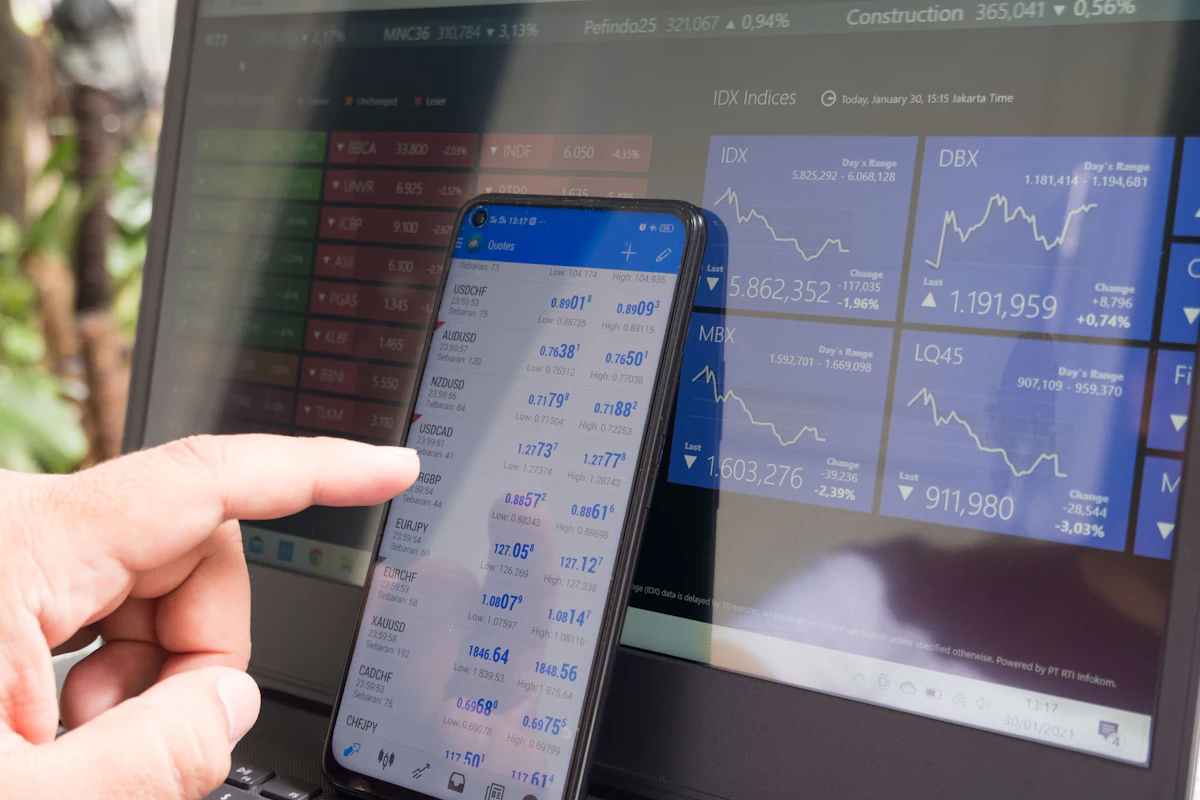
Copy trading means that one account follows another. You choose a trader whose results you have looked at, decide how much of your money follows them, and each trade they make is copied into your account in proportion to that amount. You don't place each order yourself, and you don't have to watch the market all day.
It is a way to put a trader's decisions to work in your own account. It is not a way to remove risk. This guide covers what happens in your account when you copy, what it costs, where your results can differ from the trader's, and how to decide whether copying fits you at all.
What actually happens when you copy someone
When you start copying, you choose the amount to put behind the trader and a loss limit, or you choose no limit. The loss limit is the loss at which copying stops, so that a bad run cannot take more than the level you set. It is set when you start the copy and stays fixed for that copy.
From then on, each trade the trader makes is mirrored in your copy. What gets mirrored is the result: if a trade returns 4%, the part of your copy behind that trade moves by 4%. You can stop copying whenever you like.
A simple example shows the idea. Say you copy a trader with $1,000. The trader closes one trade for a gain of 3%, then another for a loss of 2%. Your copy gains 3% on the amount behind the first trade and loses 2% on the amount behind the second. Neither move needs anything from you, and neither is a promise about the next trade.
The results will not be identical to the trader's own results, and it is worth understanding why:
- Start date. Only trades the trader opens after you start are copied. A trade that was already open when you began is not part of your copy.
- Pauses and stops. While a copy is paused, or after you have asked it to stop or it has reached your loss limit, no new trades are opened for it. Trades already open run on until they close.
- Sizing. Your copy is scaled to your amount, and amounts are rounded to the cent in your favour. Small differences are normal.
- Your own limit. If your loss limit is reached, your copy stops even if the trader carries on and recovers.
None of this makes copying unfair. It does mean that a trader's published return is a record of their own trading, not a promise about yours.
What it costs
Free to copy: there is no fee to open or hold a copy. Each trader takes a share of the profit they make you, shown on their profile before you copy. The share is set per trader, from 10% to 20% on our platform, and it is fixed for your copy on the day you start it.
The rule that decides when you pay is worth reading twice. You pay a share only when your copy reaches a new profit high. If it falls after a high, you don't pay again until it's above that high, and share already paid on an earlier high isn't refunded.
That detail matters more than it looks. Here is the same rule worked through for one copy of $1,000 at a 15% share.
| What happens | Profit so far | Share paid |
|---|---|---|
| The copy makes $100 | $100 | $15.00, a new high |
| It then loses $100 | $0 | No share |
| It makes $60 | $60 | No share, still below the high |
| It makes $70 more | $130 | $4.50, on the $30 above the old high |
Across the whole run the trader has been paid $19.50. The $15.00 paid on the first high is not refunded when the copy falls back, and nothing more is paid until the copy is above that high again. A trader with a smaller profit share is not automatically better value than one with a larger share and a steadier record, so compare the record, the risk and the share together.
What copy trading isn't
It isn't a managed fund. Nobody is making decisions for you as a client, and the trader is not acting as your adviser. You choose who to follow and when to stop.
It isn't a guarantee of income. Past months are history, not a forecast. A trader who made money for two years can have a losing year, and the copy will lose money with them.
It isn't passive in the sense that you can forget about it. You still need to review who you copy, check how much of your pot a bad run could take, and stop when the reason for copying has changed.
It isn't advice. We show the record, the risk score and the drawdown. We don't tell you which trader is right for you, because we don't know your circumstances.
The risks to look at before you copy
Copying shares the trader's losses as well as their gains. Before you start, look at:
- The record. How long is it, and does it include bad years as well as good ones? A three-year record is more useful than a good month.
- Drawdown. The biggest fall from a peak in the record tells you how deep the bad periods have been. A 30% drawdown is a very different experience from a 5% one.
- Risk score. Our traders carry a risk score from 1 to 7. Higher scores mean bigger swings, in both directions.
- What they trade. A gold trader behaves differently from an index trader, and a strategy built for calm markets behaves differently when markets are not calm.
- Your loss limit. Decide it before you start, not during a bad week.
The loss limit is a guard rail, not a guarantee. Prices can gap and move quickly, so the amount you end up with can differ from the exact number you set.
How to choose between traders
A directory of traders can feel like a shop window. These questions turn it into a decision.
How long has the record been running? Read the monthly returns from the first month. A record that began in a rising market tells you little about how the trader copes when prices fall.
What did the worst month look like? Every record has one. If it is bigger than a loss you could sit through, the trader is too risky for you at that amount, however good the average looks.
Does the risk score match the drawdown? A low score beside a deep drawdown deserves a closer look at the monthly returns. One very bad month can hide inside a calm record.
What does the share cost on your amount? At the top of the range, 20% of every new high is the price of the trader's work. Make sure the record has paid for it.
Could you explain the strategy in one sentence? If you can't say what the trader trades and why, you will find it hard to judge whether a bad month is normal or a warning.
It is usually wiser to start with one or two traders you understand than to spread a small amount over ten whose records you have only glanced at. Spreading across several traders reduces the effect of any one of them, but only if each of them is one you have actually looked at.
A sensible way to try it
Every account comes with a $100,000.00 demo balance. Practising with the demo first shows you how copying behaves without risking real money: how a copy appears, how a stop looks, how much the market moves from day to day. Demo money is separate from real money, so a copy opened there uses demo money only.
When you move to real money, start with an amount you can afford to lose. A copy can start from $10. Set a loss limit you are comfortable with, and give it enough time to be a fair test. Changing trader after two bad weeks is how people turn one difficult period into many.
Copy trading is a tool. It gives you access to decisions made by someone else, with your risk and your limits attached. It doesn't change the basic rule of investing: returns and risk travel together.
In short
- Copying mirrors a trader's results in your account, in proportion to the amount you put behind them. It does not remove risk.
- Your copy can lose money, and your loss limit is a guard rail rather than a guarantee.
- It is free to copy. You pay a share of profit only when your copy reaches a new profit high, and share already paid is not refunded.
- Judge a trader by the length of the record, the worst month, the risk score and the drawdown together, not by the best month.
- Try it on the demo balance first, and start with an amount you can afford to lose.