
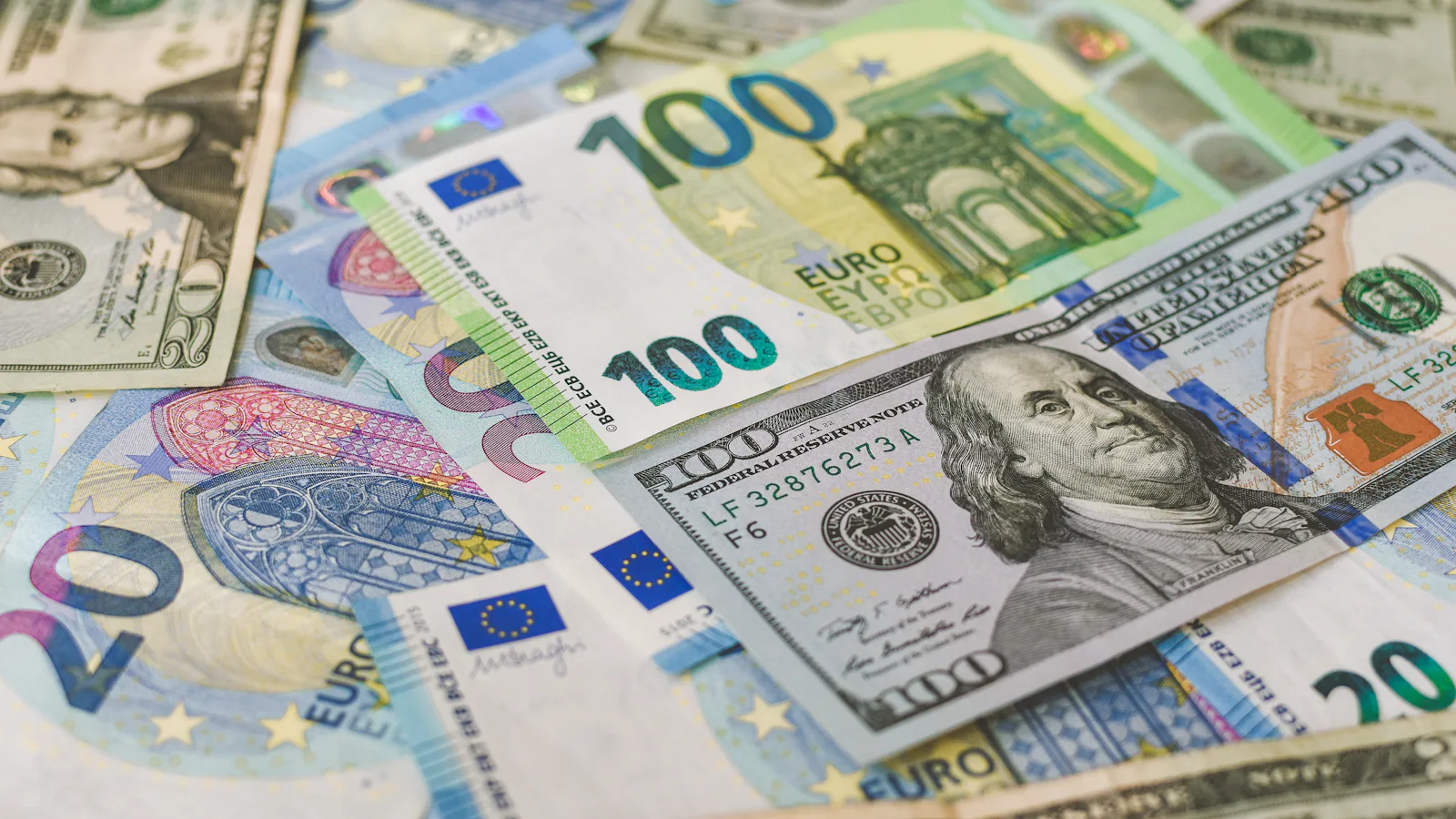
Trade the world's currencies.
The largest market in the world, open around the clock from Sunday evening to Friday evening. Compare the major pairs and what they cost before you trade.
- Instruments
- 16
- Trading hours (UK time)
- 24 hours, Sunday 22:00 to Friday 22:00
- Typical cost
- Spreads from 1 pip on EUR/USD
- Leverage
- No leverage
What the forex market is.
Forex is the market where one currency is exchanged for another. Every price is a pair: EUR/USD says how many US dollars one euro buys. There is no single exchange. Banks, companies, funds and individuals trade through a network of dealers, which is why the market stays open around the clock from Sunday evening to Friday evening.
On Replicate Traders you buy a pair when you expect the first currency to rise against the second, and you close by selling it back. Buy EUR/USD and you are buying euros with dollars; if the euro gains on the dollar, your position is worth more.
A pip is the smallest standard step in a forex price: 0.0001 on most pairs, and 0.01 on pairs that include the Japanese yen. Spreads are quoted in pips, so a spread of 1 pip on EUR/USD is 0.0001.
What moves currency prices.
Currency prices move with interest-rate decisions and expectations, inflation and employment data, and political events. When one currency's expected return rises against another's, money tends to move towards it. Major data releases and central-bank meetings can move prices sharply and widen spreads at the same time.
- Interest rates
- Central banks set the rate a currency earns. When a bank raises its rate, or markets expect it to, holding that currency looks more attractive and demand for it tends to rise. Rate decisions, and the words around them, move prices more than any other single event.
- Inflation and jobs data
- Reports on prices, wages and employment change what traders expect central banks to do next. A figure far from the forecast can move a pair by many pips within minutes.
- Growth and trade
- Strong economies attract investment, which means buying the local currency. Companies that buy and sell across borders also exchange currency to pay for goods, so trade flows move prices over longer stretches.
- Politics and risk appetite
- Elections, budgets and conflict change how safe a currency feels. When investors are frightened, money often moves to the US dollar, the Swiss franc and the yen; when confidence returns, it tends to flow back out.
Forex trading hours.
Each bar is a 24-hour day in UK time. The gold stretch is when the market trades.
-
Forex Sunday 22:00 to Friday 22:00
London and New York overlap, 13:00 to 16:00
Forex trades from Sunday 22:00 to Friday 22:00 UK time, around the clock. The busiest hours are the London and New York overlap, from 13:00 to 16:00 UK time, when spreads are usually tightest.
The market follows New York's schedule, so the open and close can move by an hour in the weeks when UK and US clocks change at different dates. Spreads can widen at the open, around central-bank decisions and when major data is released.
Trading centres open in turn around the world, so there is nearly always a market somewhere. The overlap of London and New York, from 13:00 to 16:00 UK time, is the busiest stretch and usually has the tightest spreads.
When a market is closed
From Friday 22:00 to Sunday 22:00 the forex market is closed. The price you see is Friday's last close, and orders are refused until prices start moving again on Sunday evening.
Outside its trading hours a market has no new prices. The price on screen is the last close. It can still be traded for a short while after the close, until the price we hold is older than the market accepts: 2 minutes for most markets, and a little longer for the markets whose free data arrives late (the delay of that data plus 2 minutes). After that, buying and selling are refused until the market opens and the price updates.
Forex pairs to trade.
Every instrument in this market, their trading hours in UK time and their typical spread or cost.
| Instrument | Name | Trading hours (UK time) | Typical spread or cost |
|---|---|---|---|
| EUR/USD | Euro / US dollar | 24 hours, Sunday 22:00 to Friday 22:00 | From 1 pip |
| GBP/USD | British pound / US dollar | 24 hours, Sunday 22:00 to Friday 22:00 | From 1.3 pips |
| USD/JPY | US dollar / Japanese yen | 24 hours, Sunday 22:00 to Friday 22:00 | From 1.1 pips |
| USD/CHF | US dollar / Swiss franc | 24 hours, Sunday 22:00 to Friday 22:00 | From 1.4 pips |
| AUD/USD | Australian dollar / US dollar | 24 hours, Sunday 22:00 to Friday 22:00 | From 1.2 pips |
| USD/CAD | US dollar / Canadian dollar | 24 hours, Sunday 22:00 to Friday 22:00 | From 1.4 pips |
| NZD/USD | New Zealand dollar / US dollar | 24 hours, Sunday 22:00 to Friday 22:00 | From 1.7 pips |
| EUR/GBP | Euro / British pound | 24 hours, Sunday 22:00 to Friday 22:00 | From 1.5 pips |
| EUR/JPY | Euro / Japanese yen | 24 hours, Sunday 22:00 to Friday 22:00 | From 1.6 pips |
| GBP/JPY | British pound / Japanese yen | 24 hours, Sunday 22:00 to Friday 22:00 | From 2.3 pips |
| EUR/CHF | Euro / Swiss franc | 24 hours, Sunday 22:00 to Friday 22:00 | From 1.8 pips |
| EUR/AUD | Euro / Australian dollar | 24 hours, Sunday 22:00 to Friday 22:00 | From 2.4 pips |
| EUR/CAD | Euro / Canadian dollar | 24 hours, Sunday 22:00 to Friday 22:00 | From 2.6 pips |
| AUD/JPY | Australian dollar / Japanese yen | 24 hours, Sunday 22:00 to Friday 22:00 | From 1.9 pips |
| GBP/CHF | British pound / Swiss franc | 24 hours, Sunday 22:00 to Friday 22:00 | From 2.9 pips |
| USD/SGD | US dollar / Singapore dollar | 24 hours, Sunday 22:00 to Friday 22:00 | From 1.8 pips |
Typical spreads are for a standard account while the market is liquid; they can widen around news and at the open. No commission; the spread is the cost, and it is shown before you confirm. Trading is unleveraged: you can lose what you put in, not more.
EUR/USD, live.
The live chart for this market's lead instrument. Prices are indicative and may be delayed.
How a trade works here.
Four steps, the same in every market. Nothing is borrowed, and the price you see is the price you trade at.
-
Pick an instrument and read its two prices
Every instrument shows a buy price and a sell price. You buy at the higher one, the ask, and you sell at the lower one, the bid. The gap between them is the spread, and it is the only thing a trade costs: there is no commission.
-
Choose how much to buy
Enter an amount. The smallest buy order is $10. It is paid from the money in your account, so nothing is borrowed and there is no leverage. Real-money trading needs an approved identity check; the demo balance does not.
-
Confirm, and the order fills at the live price
A market order fills straight away at the live price: a buy at the ask, a sell at the bid. If the price has moved against you by more than twice the spread since you last looked, the order stops and asks you to check the new price, so you never fill at a price you were not shown.
-
Sell to close
You close a position by selling what you hold. You can only sell what you own, so the most a position can lose is what you put into it. Limit and stop orders are there too: they wait until the price reaches the level you set.
The rules the platform keeps for you.
- No leverage
- You trade with your own money only. You can lose what you put in, not more.
- No stale prices
- Every market has a limit on how old a price we take. For most it is 2 minutes. A few use free data that arrives late, such as shares outside the US, futures and some indices: they take a price up to that delay plus 2 minutes old, so you trade at the late price the screen shows, and the screen says how late it is. If the latest price we hold is older than the market's limit, it is treated as closed and the order is refused with this message: "This market's price is delayed or the market is closed, so it can't be traded right now."
- Price protection
- A market order is refused if the fill would be worse than the price you confirmed by more than twice the spread. A better price is fine.
- Practise first
- Every account comes with a $100,000.00 demo balance. Demo money is separate from real money.
What can go wrong.
Investing and trading involve risk. The value of your investments can go down as well as up, and you may get back less than you put in. Past performance is not a guide to the future.
Prices can move fast
Data releases and central-bank decisions can move a pair within seconds, and spreads widen when they do. If the price moves against you by more than twice the spread before you confirm, we stop the order.
Small moves, so spreads matter
Currency prices often move in small steps, so the spread is a large part of the cost of a short-term trade. Trading in and out many times adds those costs up.
Weekend gaps
The market closes at the weekend, and news does not. The price can reopen on Sunday evening away from Friday's close, and you cannot trade until it does.
Unleveraged is not risk-free
You trade only with your own money, so you can lose what you put in but not more. A currency can still fall against the dollar for months.
Anything about trading hours, costs or the rules is in the table, the chart and the sections above. For anything else, the help centre has more.
Questions about forex.
What are forex trading hours?
Forex trades from Sunday 22:00 to Friday 22:00 UK time, around the clock. The busiest period is the London and New York overlap, from 13:00 to 16:00 UK time.
What is a pip?
A pip is the smallest standard step in a currency pair. On EUR/USD, one pip is 0.0001. Typical spreads are quoted in pips, and EUR/USD starts at 1 pip.
Is leverage available?
No. Trading on our platform is unleveraged: you can lose what you put in, not more, so a position cannot cost more than the amount you choose.
Which pairs can I trade?
The major pairs against the US dollar, such as EUR/USD, GBP/USD and USD/JPY, and the most-traded crosses between other currencies, such as EUR/GBP and EUR/JPY. The table above lists the most-traded pairs, their hours and their typical spreads; Discover lists every pair.
What does a forex trade cost?
There is no commission. The cost is the spread, shown before you confirm, and EUR/USD starts at 1 pip.
Why is the price not moving on a Saturday?
The forex market is closed from Friday 22:00 to Sunday 22:00 UK time. The price on screen is the last close and it cannot be traded until the market reopens.
Open an account to trade forex.
Trading is unleveraged: you can lose what you put in, not more.