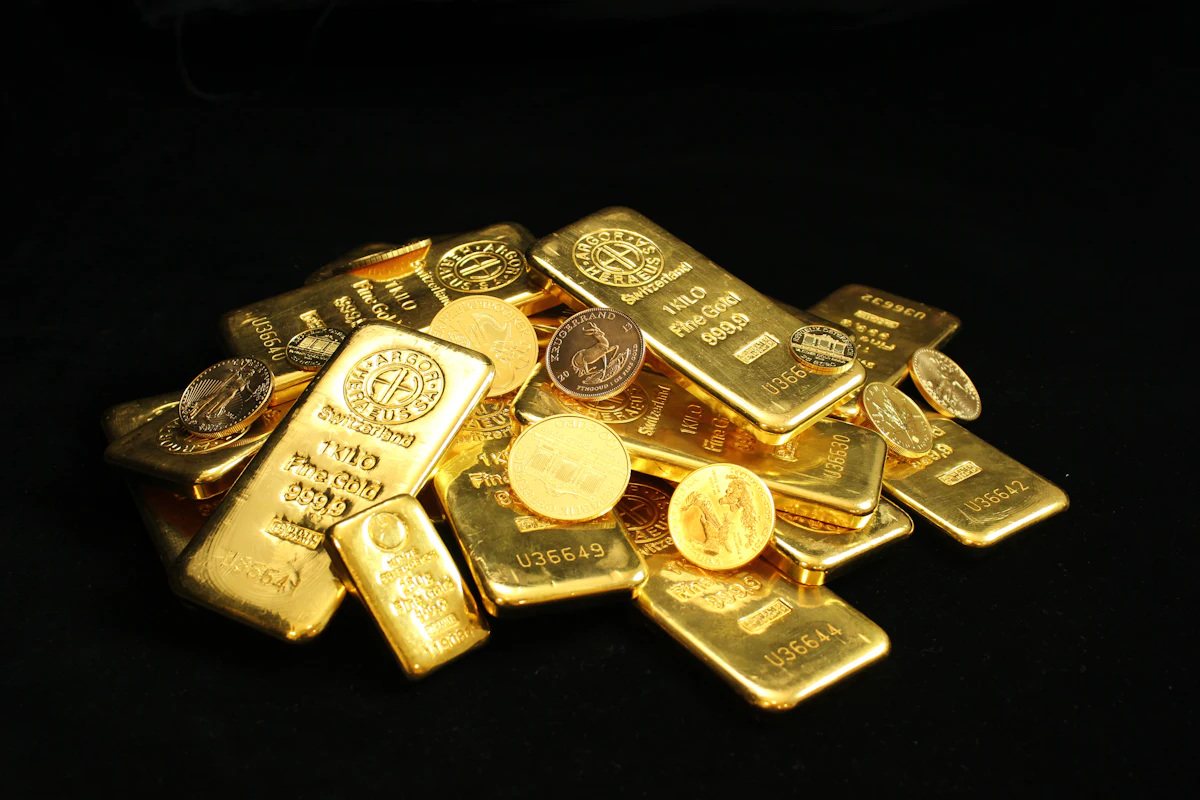
Gold is quoted in US dollars per troy ounce, and it trades on over-the-counter markets and on exchanges around the clock during the working week. Unlike a company, gold produces no earnings. Unlike a bond, it pays no interest. Its price is set by supply and demand, and by how people feel about holding money that does nothing instead of money that does.
This guide covers where gold comes from, who buys it, the six forces that move its price, a worked example of the interest-rate link, the myths that trip people up, and what it means if you trade it.
Supply is slow to change
Most gold ever mined is still above ground, held in vaults, jewellery and reserves. New supply comes from mine production and recycling. Mines are expensive to build and slow to change: a new mine can take a decade to reach production, and output from existing mines rises and falls with ore grades, energy costs and disruptions.
That means supply responds weakly to price in the short term. When demand jumps, the new gold usually comes from existing stockpiles and recycling rather than from new mining. It also means supply is rarely the reason a price moves in a given week. The week-to-week story is nearly always about demand and expectations.
Demand has four main parts
- Jewellery is the largest single use of new gold, led by India and China. It is sensitive to price and to local incomes, and demand often falls when the price spikes.
- Central banks hold gold as a reserve asset. Their buying is slow-moving but powerful, because central banks buy in large volumes and hold for years. Their sales and purchases have had outsized effects on the market in recent decades.
- Investment covers bars and coins, exchange-traded products backed by physical gold, and futures. This demand rises when investors want a store of value outside banks and currencies, and falls when higher-yielding assets look more attractive.
- Industry uses gold in electronics because it conducts electricity well and does not corrode. This is a small share of total demand but it is stable and offers manufacturers little substitute.
The forces that move the price
Real interest rates. This is the biggest single driver. Gold pays no interest, so the return you give up by holding it matters. When real interest rates, which are rates after inflation, are very low or negative, the cost of holding gold is small and its price tends to do better. When real rates rise, bonds pay more and gold competes worse.
The US dollar. Gold is priced in dollars, so a stronger dollar usually makes it more expensive for buyers in other currencies, and the price tends to fall. A weaker dollar has the opposite effect. This is a relationship, not a law, and it breaks down from time to time.
Inflation and expectations. Gold is often bought as protection against inflation, but the market moves on expectations rather than on old data. If inflation rises but interest rates rise faster, gold can fall. If markets expect cuts while inflation persists, gold often rises.
Central bank buying. Large, sustained purchases by central banks reduce the gold available to the market and can support the price for years. Their reasons are usually about reserves and diversification, not about short-term returns.
Geopolitics and fear. Wars, sanctions and financial stress tend to push money toward gold, at least briefly. These moves can be sharp and can reverse quickly when the immediate fear fades.
Market flows. Exchange-traded funds and futures markets make it easy to move large amounts of gold exposure quickly. When funds see large inflows, they buy gold; when they see outflows, they sell. Short-term positioning can exaggerate moves in both directions.
A worked example: why rates matter to a metal that pays nothing
Suppose you have $10,000 and two choices for a year. One is a savings product that pays 4% after inflation. The other is gold, which pays nothing. To be worth holding, the gold would have to rise by about 4% over the year after inflation just to match the savings product, which gives you $400 more than you started with.
Now suppose the savings rate after inflation falls to 0%. The same comparison now asks gold to beat nothing at all. The bar has dropped, and some holders move money towards gold. That is the real-rate link in one picture: gold does not need to do anything different for its appeal to change. The alternative changes.
The dollar adds a second layer. A buyer in another currency pays in dollars, so when the dollar strengthens by 5% against that currency, the same ounce costs that buyer about 5% more to buy before the gold price itself has moved. Rising prices in dollars can still be falling prices in some other currency.
Myths worth dropping
"Gold always rises in a crisis." It often does in the first moments of fear. It does not always hold the gain, and in some sharp sell-offs investors sell gold along with everything else to raise cash.
"Gold protects against inflation month by month." Over very long periods gold has kept its purchasing power better than paper money. Over months, the link is weak, and the price follows expectations about interest rates more than the latest inflation figure.
"The price is the same everywhere." The spot price, the price of a futures contract and the price of a coin or a bar can differ. Dealers add a premium to physical gold, and futures prices include the cost of carrying gold to a later date.
"Gold is safe." A metal that pays nothing can still fall by a fifth or more in a year. It is a different kind of risk from a share, not an absence of risk.
How gold is traded
Most wholesale gold trades over the counter between banks and dealers, with the London Bullion Market Association setting the standards and publishing a twice-daily benchmark, the LBMA Gold Price. Futures trade on exchanges such as COMEX in New York, where a standard contract is for 100 troy ounces. For a private trader, the practical market is the spot price: the price for immediate delivery, quoted per ounce.
On Replicate Traders you trade the price of gold as XAU/USD, in the commodities and indices market. You do not take delivery of any metal. The listed hours are Sunday 23:00 to Friday 22:00 (daily break 22:00–23:00), and the typical spread is from 3.0 points. A gold point is $0.10 an ounce, so a spread of 3.0 points is $0.30 an ounce. No commission, and trading is unleveraged: you can lose what you put in, not more.
The market takes a daily break, shown in the hours above, and is closed from Friday evening to Sunday evening. During those hours the price on screen is the last close and orders are refused until trading resumes.
What this means for a trader
Gold is volatile in a different way from an individual share. It can trend for months, then move violently on a single interest-rate decision. Spreads can widen around major data releases, and overnight gaps are common.
If you trade gold, the same rules apply as anywhere else:
- Size positions so a bad move is survivable. Decide in dollars what a 5% fall would cost you before you place the order, not after.
- Know what data is due. Interest-rate decisions, inflation reports and the US jobs report are the usual catalysts. Spreads are wider around them.
- Don't assume a safe-haven story means a one-way price. A frightened market can buy gold one day and sell it the next.
- Check the spread and the hours. The cost of a trade is the spread, shown before you confirm, and gold has a break every evening.
A gold chart is a record of supply, demand and expectations, and all three can change quickly. Practising on the $100,000.00 demo balance first is a cheap way to see how it behaves on a rate-decision day.
This is general information about how a market works. It is not a forecast, and it is not investment advice.
In short
- Gold pays no interest, so its price depends on what you give up by holding it. Real interest rates are the biggest single driver.
- A stronger dollar usually weighs on gold, and fear often supports it, but neither is a rule.
- Supply barely changes in the short run. Week to week, demand and expectations move the price.
- On Replicate Traders you trade the price as XAU/USD with no delivery, no commission and no leverage. Check the spread and the hours before you confirm.
- Gold can fall as well as rise, and it moves sharply on news.